The Queer Person’s Guide to Expat Taxes
The gist: the thing about queer people moving abroad is, we’re usually not doing it for a tax break.
Written by Jess Drucker, Founder of Rainbow Relocation Strategies
Published on RainbowRelo.com
Ugh, why do you have to make everything about being queer…. even taxes?
Well, if I’m honest, taxes, tax breaks, tax incentives… that was one of those constant papercuts that actually caused me to create Rainbow Relocation Strategies in 2022.
Yes, I was most motivated by the overturn of Roe v Wade that summer. However, from when I started helping clients in 2018 through 2022, I was always aware that my cis hetero clients, my straight couples, were able to at least consider as a reasonable filter whether a country had better tax advantage than the US.
Deals. Discounts…. But all my queer clients are ever truly looking for is Dignity.
We’d love to live somewhere with no income tax. Or lower taxes. But LGBTQ+ folks and families are relocating abroad because we want to live somewhere that allows us to live freely, to age in a country without homophobic or transphobic healthcare practices, where our kids can grow up in schools where their family isn’t a controversy.
We’d want to walk into a government office, a hospital, a landlord’s office, and not have to brace ourselves.
We move for dignity, for safety, for the kind of ordinary life that shouldn’t feel radical but does.
Taxes are not the point. And some of us don’t mind paying higher taxes in exchange for that dignity and freedom. So, let’s talk about it.

The Tax Reality for LGBTQ+ Expats
At Rainbow Relocation, we work with queer people and families who are thinking carefully about where in the world they want to build their lives. Part of that thinking is financial. And one pattern we see consistently is this: the countries that score highest on LGBTQ+ rights, legal protections, and social inclusion tend to also have higher tax rates.
That is not a coincidence. The Netherlands, Germany, France, Portugal, Spain, Canada, New Zealand: these are places where queer families genuinely thrive, and they are also places that fund their social fabric through meaningful tax contributions. Universal healthcare, strong public schools, robust infrastructure, and real social safety nets cost money. And for many of our clients, those things are not just nice to have. They are part of why the move makes sense.
On the other end of the spectrum, lower-tax locations, places like Mexico, Costa Rica, Albania, Georgia, can look appealing on paper. Our job at Rainbow Relocation is to make sure our clients are looking at the full picture: not just what they’d save on taxes, but what the legal landscape looks like for their relationship, their family structure, their healthcare needs, and their daily life. Tax efficiency is one input. It is not the only one. There is no universal right answer.
And we are not tax experts by any means. We have have a network of tax professionals to help.
First, let’s just go over the basics.
The Basics: How US Expat Taxes Work
Double Taxation: The question we field most often from Americans considering a move abroad: am I going to be taxed twice?
The answer, in almost every case, is no. Here is why.
The United States taxes its citizens on worldwide income, which means you file a US tax return every year regardless of where you live. But filing and paying are two different things. Two tools do most of the heavy lifting:
The Foreign Earned Income Exclusion (FEIE) allows you to exclude up to approximately 30,000 of income earned while living abroad from your US taxable income. If you earn under that threshold, you likely owe nothing to the federal government.
The Foreign Tax Credit (FTC) allows you to apply taxes already paid to your country of residence as a credit against any remaining US tax liability. Between these two tools, most Americans living abroad pay taxes once — to the country where they actually live.
One area that catches people off guard is state taxes. California and New York in particular treat you as a resident even after you’ve moved abroad, unless you take deliberate steps to change your legal domicile. Florida is the most common choice — no state income tax, and a clear process. The key is to document the change: update your mailing address, voter registration, and banking address, among other steps, before or shortly after your move.
Key Tax Vocabulary Every Expat Should Know
Foreign Earned Income Exclusion (FEIE): Excludes up to ~30K of income earned while living abroad from US federal taxes. You must qualify via either the physical presence test or the bona fide residence test.
Foreign Tax Credit (FTC): A credit against US taxes for taxes already paid in your country of residence. The primary protection against double taxation.
FBAR (Foreign Bank Account Report): Required if you hold 0,000 or more in a foreign bank account at any point during the year. Filed with the US Treasury, not the IRS. There is no tax attached to it.
FATCA / Form 8938: Filed with your US tax return if you hold 00,000 or more in foreign financial accounts. A reporting requirement, not an additional tax.
Bona Fide Residence Test: One of two ways to qualify for the FEIE. If you are a legal resident of another country — you have a visa, you live and work there — you meet this test, and the 330-day rule does not apply to you.
Physical Presence Test: The second path to FEIE eligibility. Requires being outside the US for 330 days within a 12-month period. Most relevant for digital nomads without established residency in a single country.
Totalization Agreement: A treaty between the US and another country that determines which social security system you pay into. Many European countries have these agreements, which can eliminate the roughly 15% self-employment tax for freelancers living abroad.
Domicile: Your permanent legal home for tax purposes. Not the same as where you physically live. Changing it requires documented action, not just a change of address.
When the Picture Gets More Complex
For most people relocating abroad - employees, freelancers, retirees - the tax picture is manageable with the right professionals guiding the process. But we are going to be direct with you, because that is what we do: if you are a US business owner, if you are carrying significant capital gains, an inheritance, trust structures, or substantial retirement account balances, the addition of an international move introduces real complexity. Owning a foreign corporation triggers additional IRS filing requirements. Roth IRA and 529 plan balances may be treated differently under foreign tax law. Capital gains on a property sale can interact with US and foreign tax rules in ways that require careful advance planning.
None of that is a reason not to go. It is a reason to work with specialists who have seen it before and know how to structure things correctly from the start. At Rainbow Relocation, we do not work with generalists. Our expert network includes vetted tax professionals, immigration attorneys, and financial advisors who understand the specific situations our clients are navigating, and who know that the decisions queer people and families make are rarely purely financial. We bring the right people to the table for your situation.
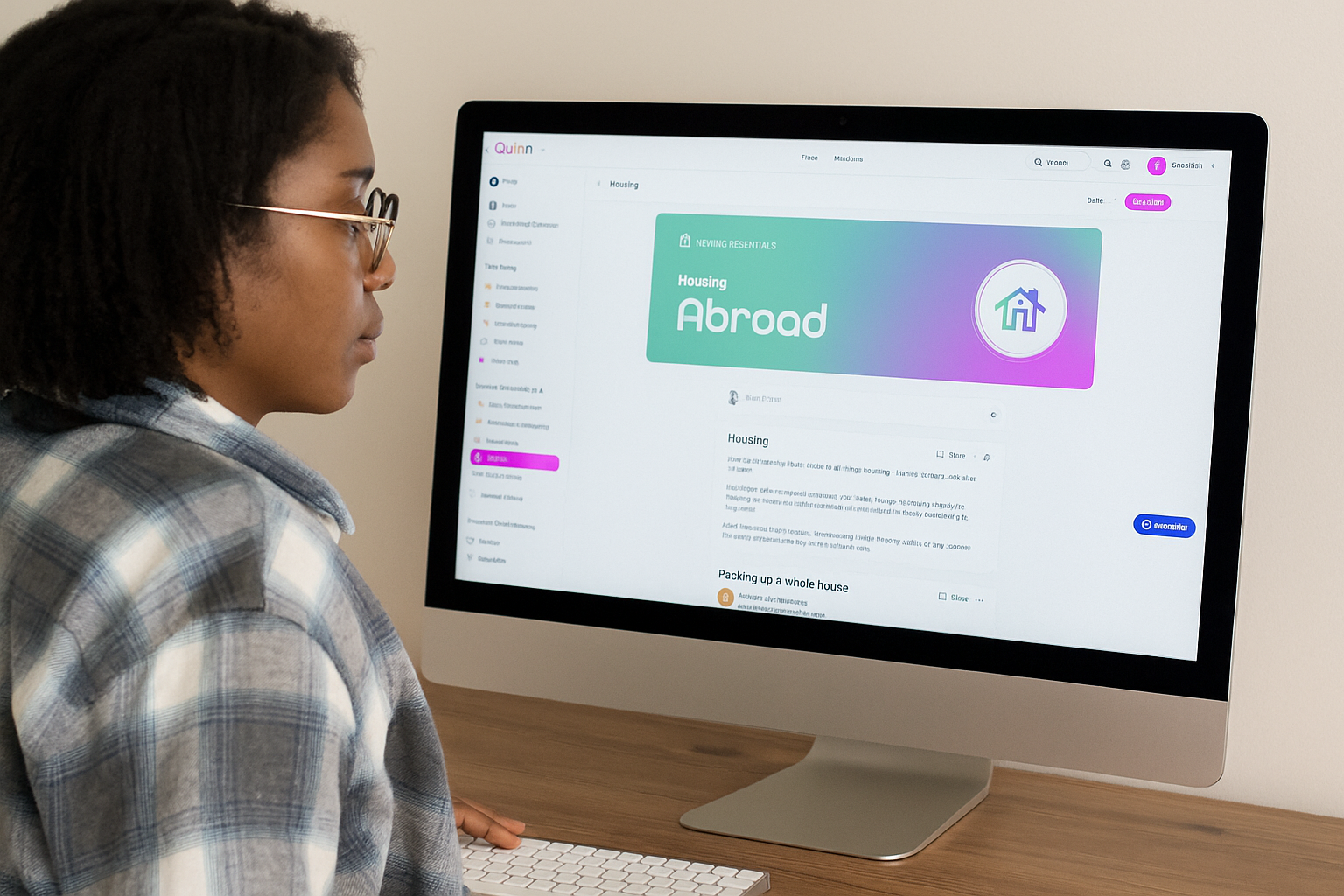
Go Deeper Inside Quinn
If you want expert answers alongside a real community of queer people who are planning moves, in the middle of moves, or already living abroad, that is exactly what Quinn was built for. Quinn is our private membership community, and it is where the substantive conversations happen.
We recently hosted a live session inside Quinn with Josh Katz, CPA, founder of Universal Tax Professionals, a firm that works with Americans in nearly 100 countries. Josh spent a full hour walking our members through these exact questions: the FEIE, foreign tax credits, FBAR, retirement accounts, business structures, state domicile, and more. Honest answers, no deflection, real expertise.
Join us at join.quinncommunity.com.
And when you are ready to plan the move itself — choosing the right country, understanding your visa options, building your professional support network, and connecting with our vetted partners. Rainbow Relocation is here to do that with you, from your first conversation to decades in to your life abroad. Start off with an hour consult with us and go from there: rainbowrelo.com/one-hour.
This post is for informational purposes only and does not constitute tax or legal advice. Please consult a qualified tax professional for your specific situation.